People First: A Portrait of Canada’s Nonprofit Workforce

Nonprofits aren’t just powered by volunteers. With 2.9 million workers, nonprofits are the largest employer in Canada. The nonprofit sector employs more people than construction, manufacturing, or retail.
Yet the realities of this workforce are often overlooked. Who are the people driving this sector forward? How do their salaries, benefits, and demographics compare to the broader Canadian labour workforce? And what challenges do they face in building sustainable careers?
Drawing on Statistics Canada data, People First: A Portrait of Canada’s Nonprofit Workforce offers the most detailed profile to date of nonprofit workers. It reveals how this workforce is distinct and why putting people first is critical to the health of the sector and our communities.
A note about Statistics Canada data: Where possible, we publish the most recent Statistics Canada data on our website. Some figures may differ from those in our reports, which use the data available at the time of publication.
- The average annual salary for a nonprofit worker is 13% lower than the average salary for all Canadian employees. For community nonprofit workers, this gap jumps to 31%
- Women account for about 70% of the nonprofit workforce. Yet gender pay gaps persist. Nonprofit female workers make 18% less than the average Canadian salary.
- Racialized employees make up 33% of the nonprofit workforce, slightly higher than the national workforce. This group earns on average 12% less than non-racialized nonprofit employees, underscoring persistent equity gaps.
- Nonprofit employees are more educated compared to other Canadian workers (48% vs 34%. Notably, 20% of the total university-educated employees work in the nonprofit sector. Yet, nonprofit workers earn less on average.

Published in April 2025, this report draws on Statistics Canada data to provide a clear picture of employees in Canada’s nonprofit sector. This analysis offers the most complete portrait yet of Canada’s nonprofit workforce.
Resources
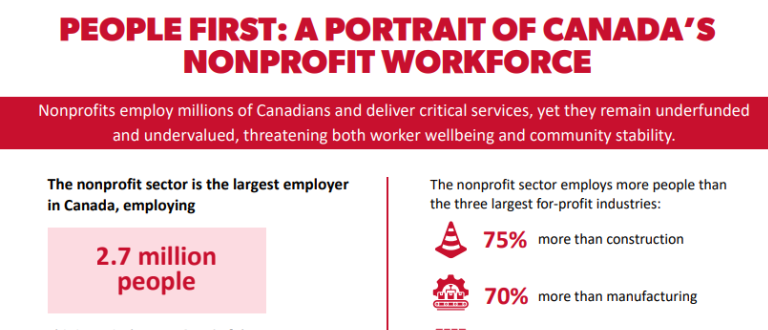
This one-pager, which provides a snapshot of the key characteristics of the nonprofit workforce, is a powerful advocacy tool.

This white paper provides a succinct and clear summary of the People First report’s main findings.
*Thank you to the Dr. Barrie Strafford Centre for Learning, Innovation, and Quality (CLIQ) for their support in developing these resources.
Improving working conditions is essential to the health of the sector and the communities it serves. Three priorities stand out:
Advocate for funding reform and leadership shifts
Current funding models often constrain how nonprofits hire, pay, and support their staff. More flexible and sustainable funding can give organizations the room to prioritize workforce needs. The Fair Funding for Nonprofits coalition is advocating for flexible, long-term funding that lets organizations invest in their people and strengthen the sector as a whole. Leadership across the sector must recognize the nonprofit workforce as a cornerstone of organizational and sector resilience.
Support decent work
With wages lower than the Canadian average and many part-time roles concentrated in community nonprofits, the sector faces ongoing recruitment and retention challenges. Advancing decent work, fair pay, benefits, stability, and opportunities for growth, is critical to sustaining talent.
Advance anti-racist and anti-oppressive practices
Racialized workers make up a significant share of the nonprofit workforce, yet they face persistent pay gaps. Addressing systemic inequities and embedding anti-racist and anti-oppressive practices in hiring, compensation, and leadership pathways is necessary to ensure a truly inclusive sector.