Highlights from Imagine Canada research
For the past year and a half, our team has been working on a public awareness campaign set to launch this Fall. The goal of this campaign - which is supported by BMO and other partners - is to show Canadians the breadth of the services delivered by charities and nonprofits and help build a sense of belonging to our sector. The size and impact of the nonprofit sector is not well known among Canadians. Most Canadians don’t realize that, every day, millions of individuals benefit from the services of nonprofit organizations. Our campaign will shine a light on the connection between individual Canadians and the services that they, family members, friends, neighbours, colleagues, have come to benefit from, expect and depend on - and illustrate how our sector affects their everyday lives, whether they see this or not.
To inform the campaign strategy, we conducted research to understand the perceptions of Canadians regarding nonprofits and charities. As we prepare to launch the campaign, we’re sharing key findings from this market research so that others in the sector can benefit from this insightful information and leverage it for their own needs.
National survey
In September 2025 we surveyed 1,500 Canadians from across the country. The poll was conducted by Ignite Research on behalf of Imagine Canada. The sample replicated the national population by region and demographics. A small oversample of 200 higher-income Canadians was included in the sample.
Key findings
Canadians value nonprofits and charities
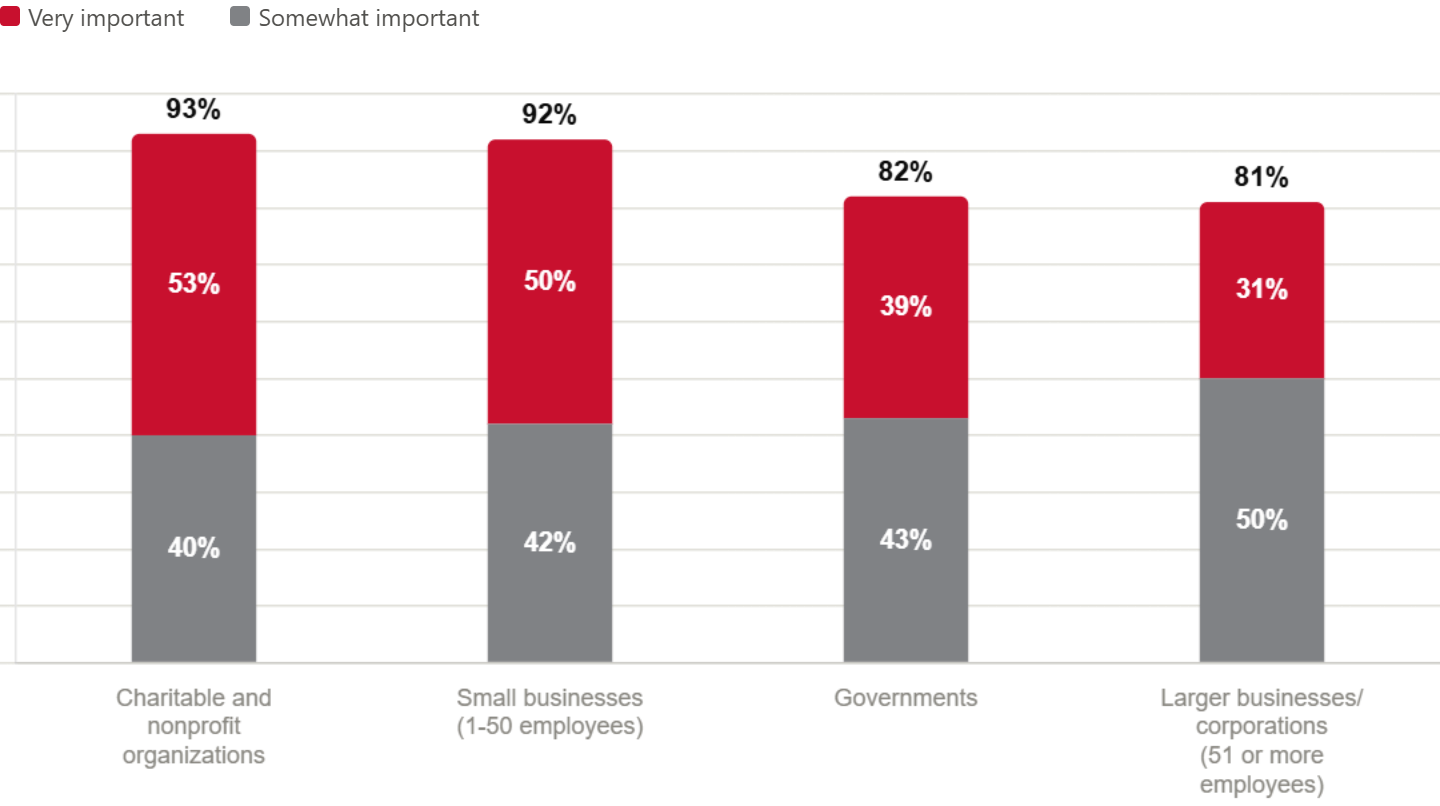
The majority of Canadians (80%) consider the services delivered by charities and nonprofits essential to the well-being of the citizens in your local community. This finding is aligned with a previous survey Imagine conducted in 2024.
Similarly, most Canadians consider the nonprofit and charitable sector more important to their local community and our way of life than other sectors. That sentiment is consistent from coast to coast and across the political spectrum. Charities and nonprofits are considered slightly more important than small businesses, and significantly more important than governments and large corporations.
Canadians are aware of the growing needs for nonprofit services
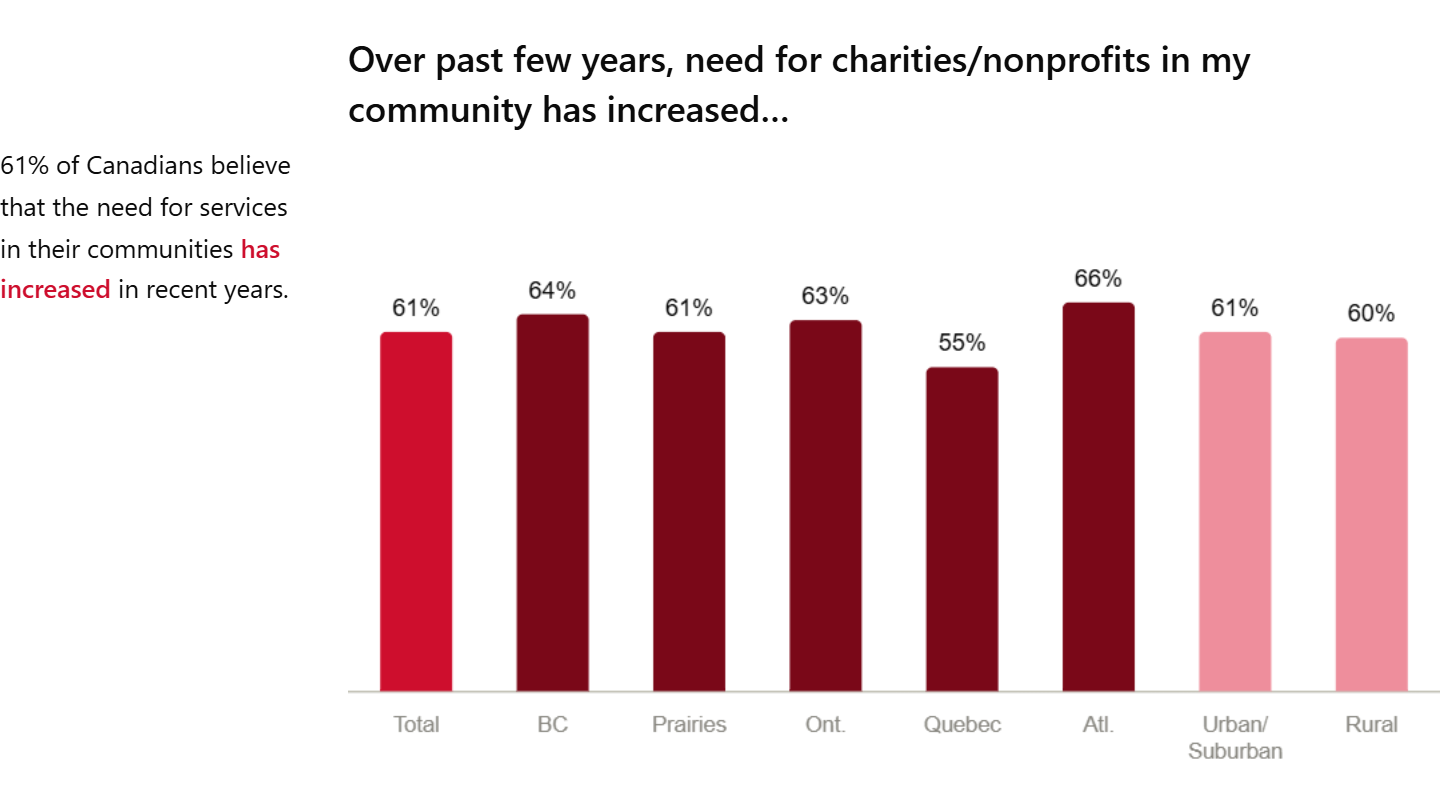
The COVID-19 pandemic had a significant impact on demand for many nonprofits and charities across the country, and the needs have continued to climb. According to research by the Charity Insights Canada Project, in 2023, 66% of responding charities reported that they had seen an increase in demand for their services in recent years. By 2025, 75% of charities reported higher demand compared to the previous fiscal year.
Two in three Canadians are cognizant of this reality.
Canadians underestimate how many people benefit from nonprofit services
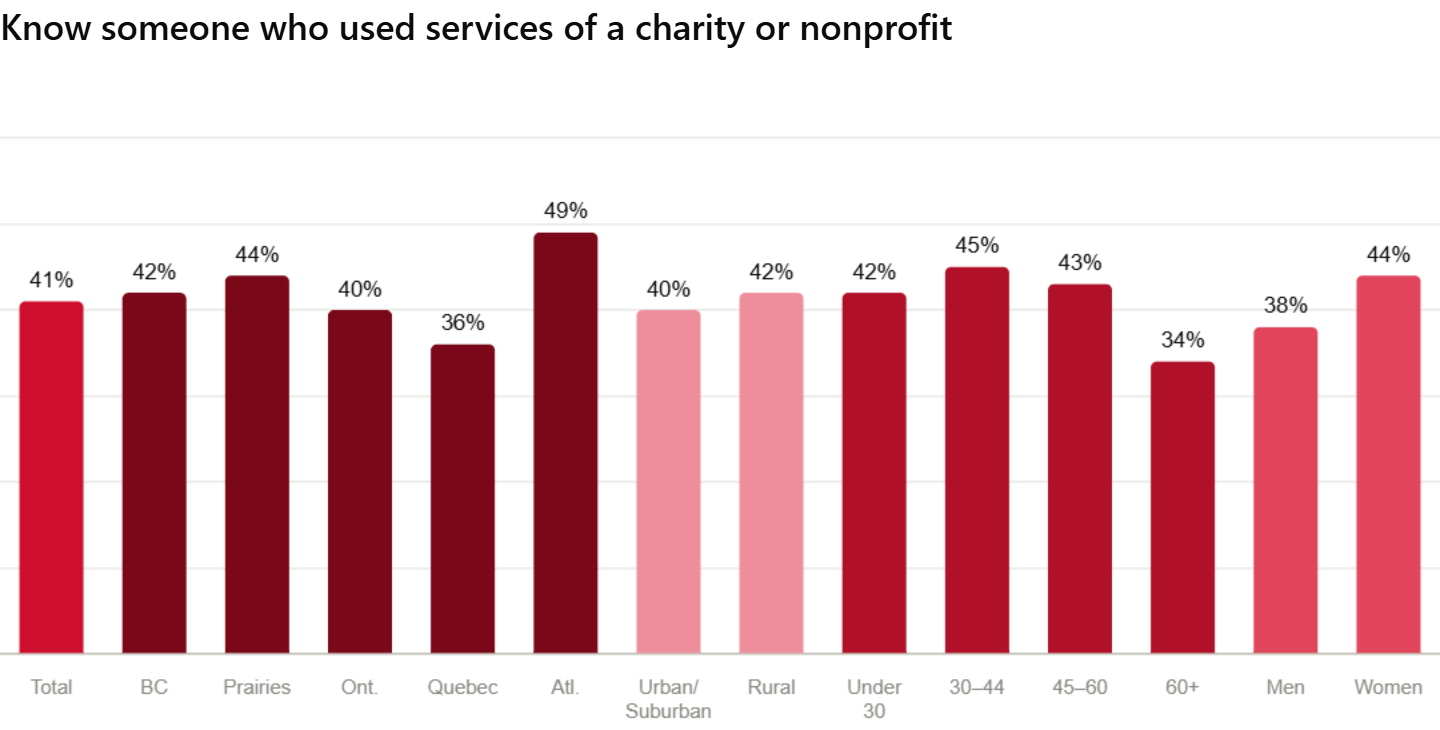
While a large proportion of Canadians are aware of the growing needs for nonprofit services, fewer say they know someone who has benefited from these services. The results vary slightly from a province to province, by age group, and by gender, with an overall average of 41%. The percentage drops to a low 34% among respondents aged over 60.
When we know that millions of people across the country access charitable and nonprofit services every day, these numbers are strikingly low, and suggest a limited understanding of the range of services nonprofits provide in communities — a gap reinforced by the 18% of respondents who were unsure whether anyone they knew had used a nonprofit's services.
Canadians think nonprofits are efficient; agree some expenses are necessary
As there are many assumptions about what Canadians think of costs, overhead, and efficiency as it relates to nonprofits, the survey asked a series of questions to get insights into this - and it’s more positive than many in our sector might assume.
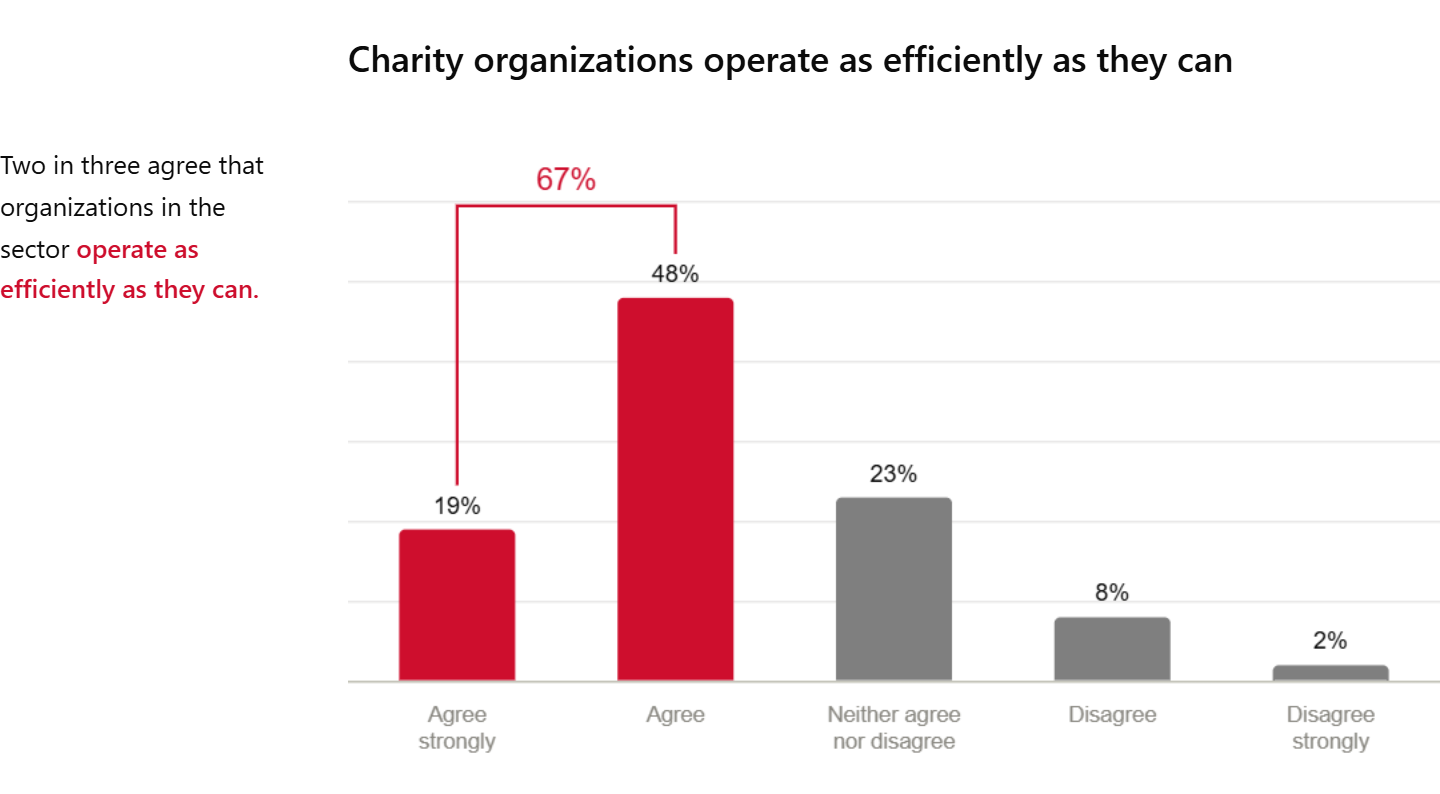
Most Canadians believe that nonprofits and charities operate as efficiently as they can. This belief is consistent across the country and among the category of higher-income Canadians included in the survey. While about one in five said they neither agree nor disagree, most likely signaling that these respondents are uncertain or don’t know, only a very small proportion of respondents disagree with this statement.
Canadians also understand that charities and nonprofits need to spend on specific activities. The expense categories that received the highest support include: protecting sensitive information; fundraising activities; technology and equipment; insurance for operations; and financial audits.
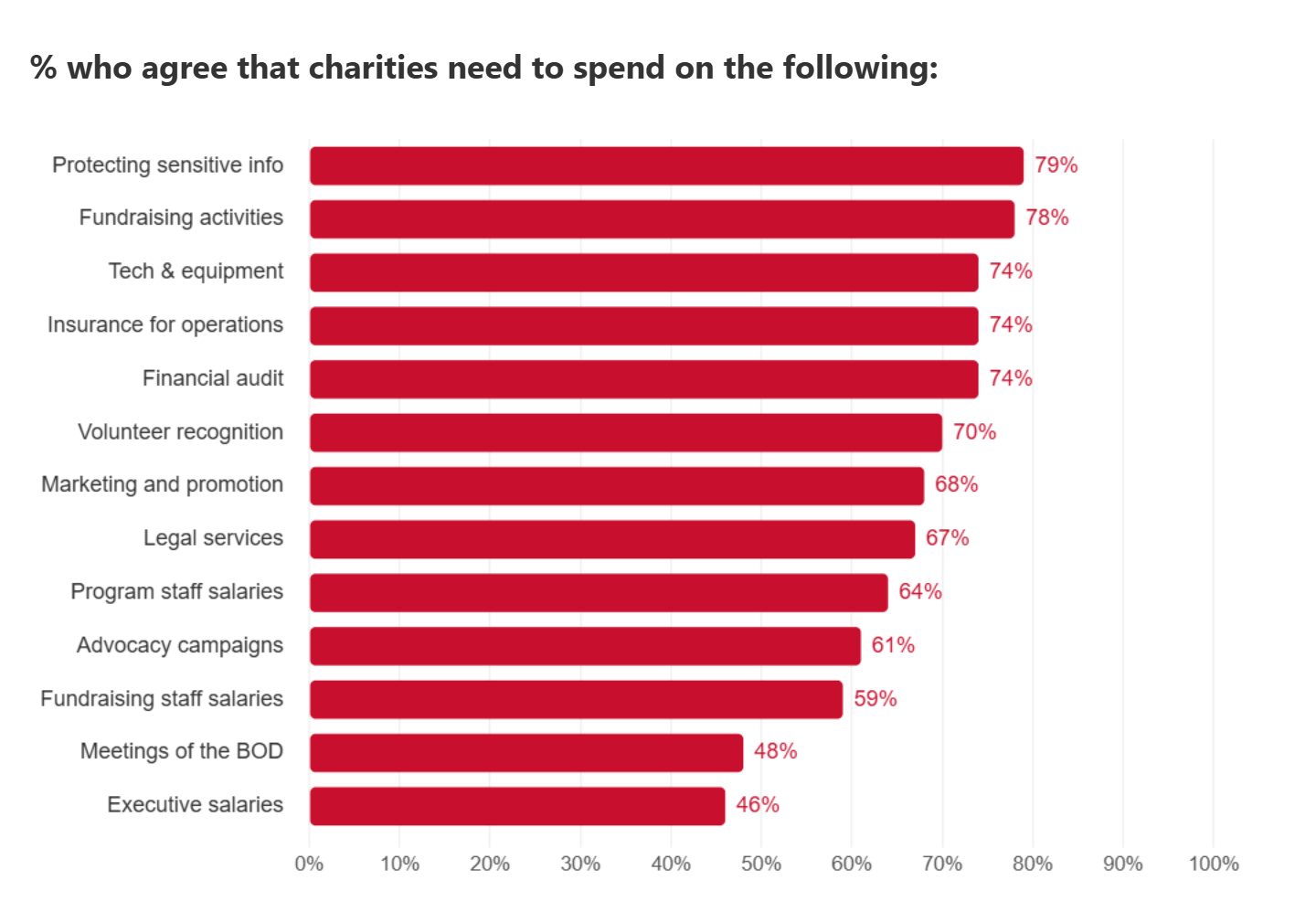
Canadians are less supportive of organizations spending money on expenses related to the leadership of an organization, such as board meetings and executive salaries.
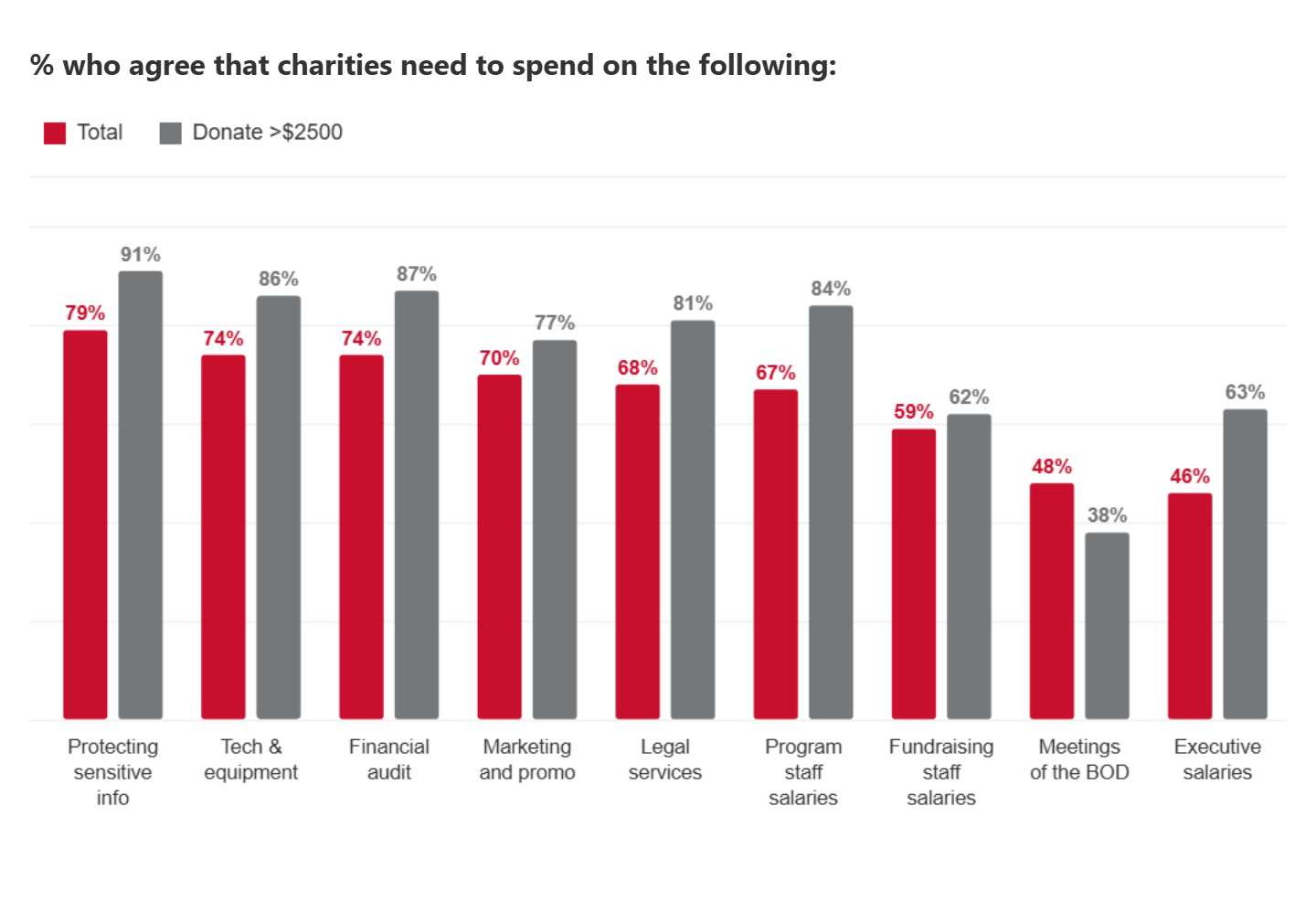
If we compare these results with those who make larger donations ($2,500 and more), we note that those who give more are generally more understanding of overhead/administrative needs.
From passion for the cause to efficiency: what matters most to Canadians when considering supporting an organization
From a list of sixteen statements, respondents were asked to select and rank the five most important factors when considering whether to support an organization. Respondents most often selected the following five:
- You have a passion for the cause / it is near and dear to you (55%)
- Belief that the charity provides services that directly benefit their local community (51%)
- Organization has a strong reputation for delivering on its promises (45%)
- Organization is operating in an effective manner (35%)
- Belief that the organization can achieve its stated goals and objectives (35%)
What about overhead?
There is a widespread assumption in the sector that people are deeply concerned about overhead. However, the survey tells us a different story; cost and overhead ranked relatively low compared with other factors people consider when deciding whether to support an organization:
- The organization has low administrative costs (22%)
- Overhead in line with industry standards (12%)
- Overhead reasonable for organization that size (11%)
Another survey we conducted in 2024 revealed that only one in three Canadians said they generally understood the actual overhead costs at charities they have supported, while 70% said they had no idea. Findings from both of these surveys suggest that overhead costs may not be as important to Canadians as we assume.
Donors care first and foremost about goals and impact
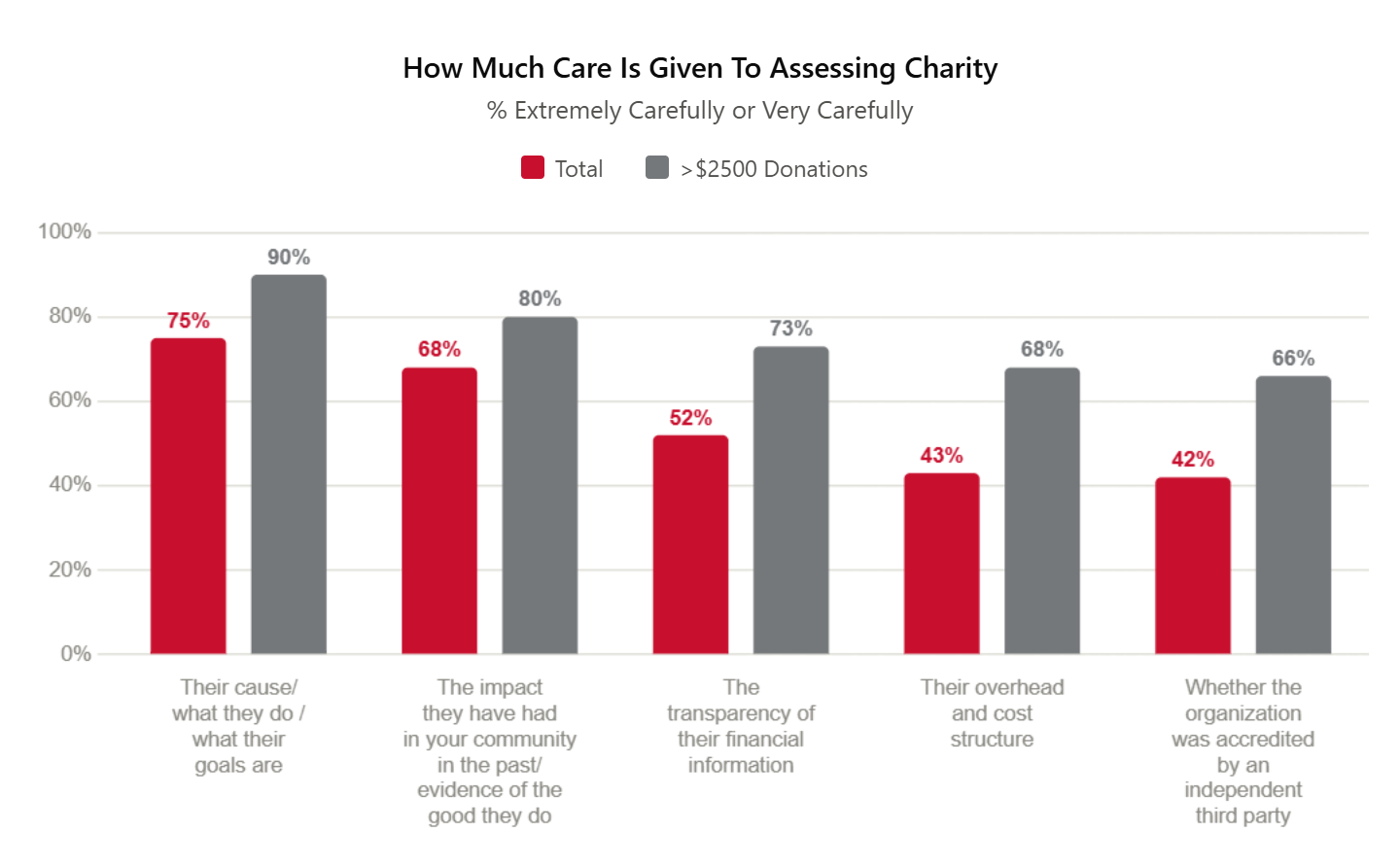
A few survey questions were asked specifically about donations. When asked how carefully they have assessed certain factors about organizations when making donations, the majority said they assess goals and impact more carefully than other factors. Compared to the other respondents, those making larger contributions ($2,500 or more) are more likely to say they focus on efficiency and transparency, but to a far lesser degree than on goals and impact. The results also show that being accredited by an independent third party, such as the Standards Accreditation, is an asset according to almost half of the respondents - a proportion that jumped to 66% among those who make larger donations.
What’s the main takeaway from this research?
This data is rich in information and there are, of course, several findings worth highlighting. But one key takeaway for us is that these data paint a more nuanced reality than we often assume in the sector. While administrative costs will always be a concern for some, the vast majority of people care far more about other considerations - and it’s with that in mind that we should build our sector narrative going forward.
Special thanks to our Presenting Partner, BMO, for supporting this research.