How are charities using grants to non-qualifying donees in their work?

Since mid-2022, Canadian charities have been able to provide money and/or resources to organizations and individuals that are not registered charities or other “qualified donees”. In this factsheet, we look at how charities used this new option during its first two and a half years.
Since June 23, 2022, with the passage of the Budget Implementation Act, 2022, No. 1, charities have been able to make grants to non-qualified donees (NQDs). This allows charities to provide monetary and material support to NQDs, so long as they can ensure that donees use that support exclusively for charitable activities that advance the charitable purposes of the granting charity.
Prior to this change, charities wanting to work with NQDs had to treat the NQD as an intermediary, with the NQD carrying out the supporting charity’s activities, on its behalf, and under its direction and control. This imposed burdensome accountability requirements on both the charity and the NQD and significantly limited how they could work together.
The new rules allow charities to provide support to NQDs to carry out the NQD’s own activities (i.e., not as intermediaries), in a manner more similar to how charities provide support to qualified donees, though with some additional accountability requirements. This is intended to make it easier for charities to work with NQDs by reducing the administrative burden on both sides, increasing flexibility and responsiveness, making better use of partner expertise, and fostering more genuine partnerships.
As part of the new rules, charities making grants to NQDs are required to report them on their annual T3010 information return and the new T1441 form, Qualifying Disbursements: Grants to Non-Qualified Donees (Grantees), for grants over $5,000. In this factsheet, we use these data to examine how charities have been using this new option in the first two and a half years of its existence.
NEW FACTSHEET
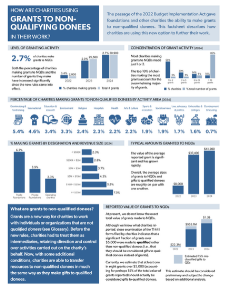
This factsheet features detailed data on grants made to non-qualified donees since 2022.
Imagine Canada and Grant Connect would like to thank Mastercard ChangeworksTM for supporting the production of the data used in this factsheet.
The number of charities making grants to NQDs is increasing, as is the number and value of grants. In 2024, 2.7% of charities made grants to NQDs, up from 0.4% in 2022. The number of grants also increased, going from 2,800 to 30,900 over the same period. Reporting issues make it difficult to determine exactly how much charities are granting, but reported amounts went from $22.3 million to $1.3 billion over the period.
The charities making grants to NQDs are more varied than one might expect. While grant making and fundraising organizations are most likely to make grants to NQDs, charities in other activity areas, most notably international development and relief, education and research, and environmental protection, also make them. Probably not surprisingly, the likelihood of making grants increases steadily with revenue size.
Compared to the supports given to qualified donees (i.e., gifts), grants to NQDs make up a relatively small portion of the support provided. Overall, grants account for about 8% of the value of support provided to donees (i.e., to both qualified and non-qualified donees). About two thirds of charities making grants to NQDs also make gifts to qualified donees. Typically, these charities devote about a third of their total support to NQDs and two thirds to qualified donees.
Most grants are monetary contributions, going to organizations working in Canada. Although about a third of grants are made to individuals, organizations receive about nine tenths of the total value of grants to NQDs. Almost all grants are monetary, with in-kind support accounting for just 1% of the value of grants. Just over two fifths of the total value of grants goes to NQDs outside Canada.
The quality of data reporting can be problematic. Overall, nearly half of charities giving some indication of making grants to NQDs look to have mis-reported their involvement in this activity. In addition, a significant fraction of reported grants look to be to qualified rather than non-qualified donees (i.e., they are actually gifts rather than grants).
CRA filings collect information about grants to NQDs in multiple areas of the T3010 and on the T1441 form for grants over $5,000. Overall, around 5% of charities give some indication of making grants to NQDs, but most of these filings contain some type of logical inconsistency. For example, about a third of charities giving an indication of making grants report grant expenditures on line 5045, but do not report the details of these expenditures on lines 5840 to 5843, or file a T1441.
For this reason, we developed an algorithm drawing on all NQD-related questions to more reliably identify charities we believe to have actually made grants to NQDs and estimate the amounts granted. These rules roughly halved our estimate of the number of charities making grants, but increased the amounts granted by 15 to 30 percent, depending on the year.
In addition to these issues, many contributions reported as grants are actually gifts to qualified donees. We are currently working to refine our estimates of what proportion of the total value of grants should be re-classified.
Want to dive deeper into non-qualified donee data? Keep an eye out for the upcoming launch of the Funding Intelligence Ecosystem in Grant Connect. The Ecosystem will offer a comprehensive look at the flow of funding in Canada. To learn more, sign up for Grantseeker or contact us at [email protected].
FAQ
Qualified donees (QDs) include many different types of organizations, including:
- registered charities,
- amateur athletic associations,
- registered journalism organizations,
- certain low-cost housing corporations for the aged,
- municipalities or public bodies performing a function of government,
- selected foreign universities,
- the provincial and federal Crowns,
- foreign charities that have received a gift in right of Canada within the last two years, and
- the United Nations and its agencies.
QDs are recognized under federal law as being eligible to receive gifts from registered charities and issue charitable receipts for donations.
Non-qualified donees (NQDs) are individuals or organizations not in the above categories. While this means they are not eligible to receive gifts from registered charities, the new legislation allows them to receive grants - provided that the grants support charitable activities that further the contributing registered charity’s charitable purpose.
While the term grant has long been used generically to describe foundation funding for other organizations and individuals, the Income Tax Act has always referred to transfers to qualified donees as gifts. With the adoption of the new rules, the word grant was chosen to refer to this new form of support for non-qualified donees. In other words, at least from a legal perspective and for the purposes of reporting to Canada Revenue Agency, grant is not a generic term and refers specifically to support for NQDs.
When making a grant under the new rules, the charity is supporting the NQD’s own activities. Previously, charities were providing resources for the NQD to carry out the charity’s program, under its direction and control. Now, charities can make grants to support activities that it did not conceptualize and it does not have to demonstrate direction and control, meaning that it does not have to retain authority over significant decisions, or monitor, supervise, and provide ongoing instructions for the purposes of controlling the activities.
However, this isn’t to say that charities have no responsibilities when granting to NQDs. Although the supported activity is legally the NQD’s, the charity has to demonstrate that the activity furthers its own charitable purposes and that the resources provided are used exclusively for charitable activities furthering those purposes. Significantly, the charity has to maintain sufficient documentation to demonstrate that these conditions are being met. Many of the reporting and payment processes may actually be quite similar to those used when working through intermediaries, but they are intended as risk management and accountability measures, rather than direction and control measures.
The new rules are a response to long-standing criticism of the previous requirements that charities could not make gifts to NQDs and were required to treat them as intermediaries carrying out the charity’s activities. This critique, mainly but not exclusively focused on working with foreign NQDs, had long maintained that the existing rules were cumbersome, inflexible, required a power imbalance to be built into relationships, and frequently prevented charities from making full use of NQDs’ knowledge, expertise, and capacities, and greatly complicated attempts to work collaboratively as part of a network or similar arrangement.
These widely held views figured prominently in testimony to the Special Senate Committee on the Charitable Sector helping inform its 2019 report Catalyst for Change: A Roadmap to a Stronger Charitable Sector, which recommended shifting to a focus on expenditure responsibility instead of direction and control. The Advisory Committee on the Charitable Sector reiterated this recommendation in its first report to the Minister of National Revenue in early 2021. This was followed by a Senate public bill proposing a new framework for supporting NQDs, which was passed by the Senate but died on the Order Paper when Parliament was dissolved for the 2021 federal election. Following this, in Budget 2022, the government announced that it intended to amend the Income Tax Act to expand the supports charities could offer to NQDs, implementing “the spirit of” Bill S-216, the substantially similar bill reintroduced after the election and then under consideration by Parliament.